
Going out with Tim Voors
A conversation with Annelies Slijpen
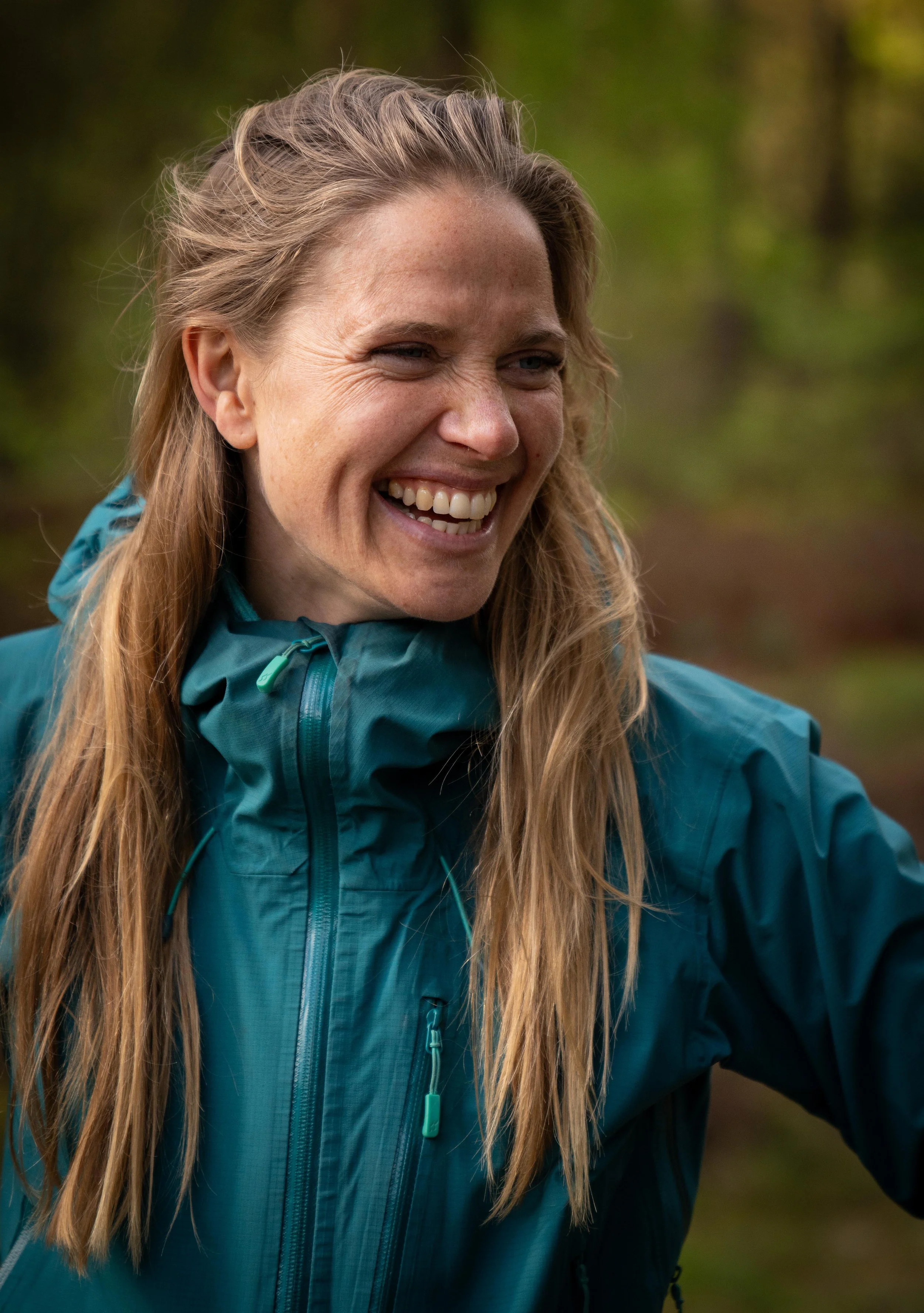
I've now worked outdoors for about twenty years. First as a PE teacher, where I taught outside for a large part of the school year. Later in specialized trauma care within the Dutch mental healthcare system (GGZ). And now as a team coach and outdoor trainer — co-owner of Out of Office Team Trainings, freelance trainer for Nature Quest and MDT Missie, and through my own company, Kampeer & Reflecteer.
But it didn't start on the job. It started with my mother
My mother passed away when I was eleven, after an eleven-year illness. She taught my father what nature can offer in terms of adventure, beauty, and support. And she in turn learned that from her mother, my grandmother.
Rain or shine, my parents took my brother and me outside to walk. And honestly, I used to find that terribly boring. The only reason I was happy to come along beforehand was the thought that we'd get hot chocolate or ice cream afterward.
Still, a lot was already being planted there. Nature and being outdoors form a common thread through my life. Being outside means adventure, movement, and fun to me, but also the place for good conversations — just sitting side by side or walking, without having to look at each other constantly.
Around the age of sixteen I went on an exchange to a family in Ashland, Oregon. They took me to the Trinity Alps, a rugged nature area in Northern California. There I discovered how vulnerable we humans really are amid the mountains, bears, rattlesnakes, and scorpions. At the same time I experienced how special it is to attach little value to possessions and instead be rich in experiences — to use your body, to walk from mountain lake to mountain lake, drink water from a spring or from meltwater, cook on a campfire, and share stories around the same source of warmth.
For four summers I returned as a guide for young people. With a group behind me I traveled through the wilderness, searching for the most beautiful sunrise and sunset, the clearest mountain lake, and the ultimate campsite. That's when I knew for sure: one day I want to do this for a longer stretch of time.
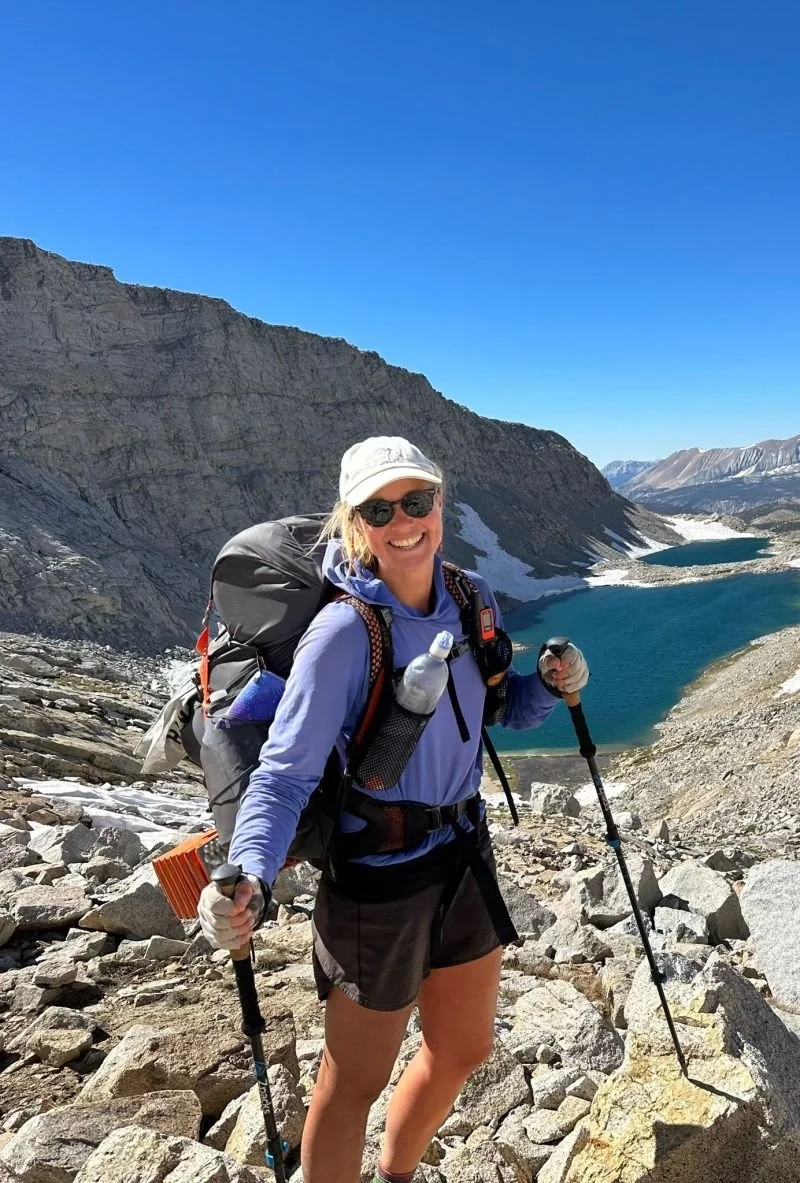
That eventually became my plan to walk from Mexico to Canada on the Pacific Crest Trail. In 2023 I got to make that dream come true. I walked more than 3,000 kilometers, border to border, in the most extreme snow year ever recorded on that route. A journey full of challenges, wonder, and humility — humility toward nature, toward its beauty, and toward the planet we live on in perfect balance.
Far from screens and society I experienced what's truly important to me. Again and again I had to get used to the transition between two worlds: one of luxury, comfort, and abundance, and a life in which my body was my only means of transport and everything I needed was on my back — a life in which hardship and beauty exist effortlessly side by side.
When I came home, I knew one thing for certain: for me, a day not spent outdoors is a day not lived.
I recently read an article that said some people average only thirty minutes outdoors per day. That struck me.
Why nature holds such power
What I've noticed over all those years is that people relax more in nature. Nature seems to bring people into a different state — as if you can almost hear them exhale. From the sympathetic nervous system (action) to the parasympathetic nervous system (rest).
When people are more relaxed, in my view there's also more room to connect — with yourself, with your body and feelings, but also with the people around you. Being outdoors takes away some of the "having to" and makes room for "being allowed to." There's fresh air, room to move, less screen use, and the colors, shapes, and sounds of nature have an almost automatic calming effect. With the right activities or invitation, more fun and creativity often arise as well.
I experience this myself too. When I run a training outdoors instead of indoors, I notice I'm more relaxed myself. Because of the colors, shapes, smells, light, and sounds of nature, I'm closer to myself. As a result I'm also more present and more in contact with the groups I work with.
In addition, using nature or the surroundings during someone's personal process can also work in a deepening way. Nature invites (with the right guidance) slowing down, feeling, experiencing, and discovering. That's exactly why conversations, insights, and connections often arise that come about less quickly indoors.
What happens the moment you take people outside
Depending on the weather (and of course the right clothing), I experience a clear difference outdoors in behavior and in the contact between people. I often see people become more playful, more relaxed, and after a short adjustment period dare to be more themselves. There seem to be fewer masks. A neat suit gives way to comfortable clothing that allows movement, and that alone already seems to change something.
Whether I'm working in education, at the Ministry of Defence, or in business, I keep seeing the same shift. Being outdoors brings a sense of aliveness. People find it easier to talk to each other, laugh more often, and seem more open to one another. There's more authenticity, more connection, and more contact, both with themselves and with the people around them.
Precisely because nature invites movement, discovery, and slowing down, I see people come out of their heads faster and be more present in the moment. That's what makes it special for me every time to take groups outdoors.
The forest as a place of recovery
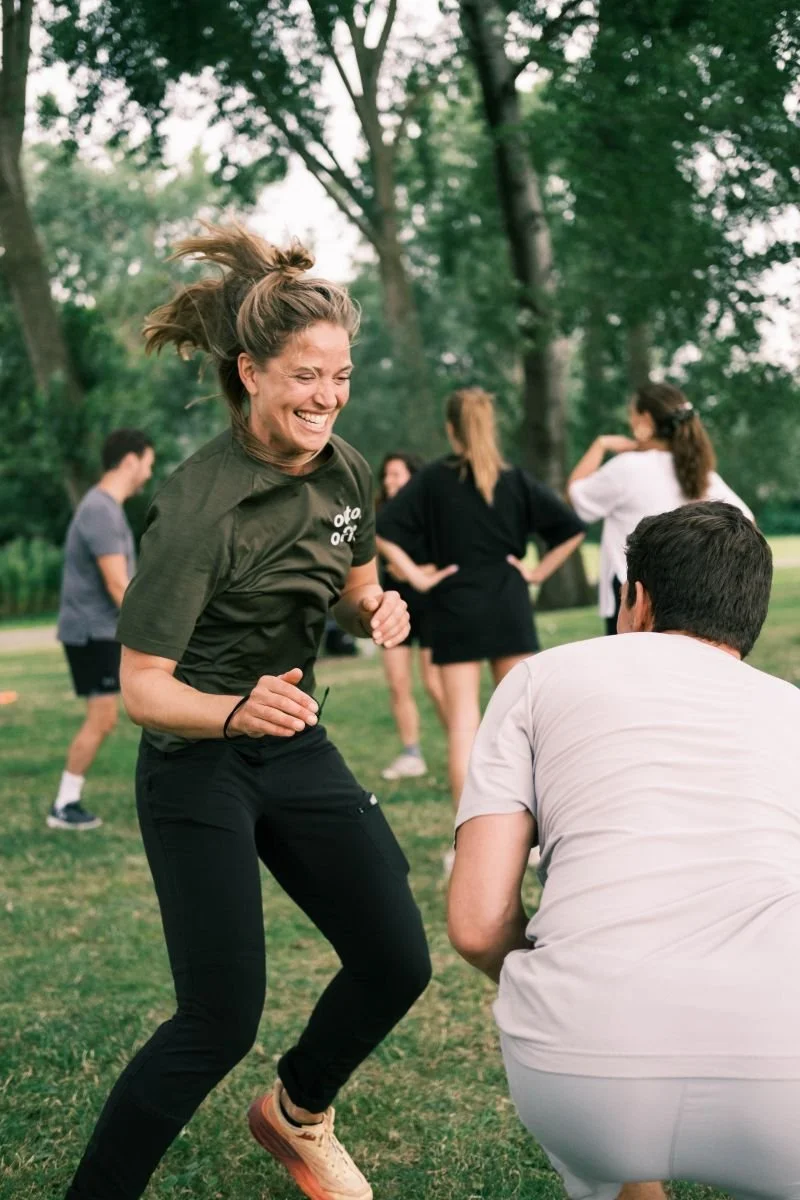
I worked for seven years in a trauma center where clients received EMDR therapy and exposure therapy. Before or after their treatment they came to me for the movement program, which always took place outdoors in the forest.
People there often went through an intensive therapeutic process. Some were extremely apprehensive about the therapy, and all emotions passed by in their purest form — from anger and rage to relief and joy.
Every day we started with a forest walk. What struck me time and again was how people could relax a little during that walk. We walked away from the clinic into the forest and always came back different — often more connected to themselves, calmer, and recharged. Despite the mentally heavy themes, being outdoors brought space and relaxation.
What helped with that was an inviting way of guiding. Sometimes we deliberately slowed the pace, sometimes I gave an assignment to look for or make something in nature. I also saw that people naturally made more contact with each other, without me having to do anything for that. Toward the end of the walk there was often laughter, and I regularly heard: "Oh right... we have to get back to work. The therapy is still there too."
Nine times out of ten, people said afterward: "I wish I could start every day like this." Rain or shine, we went outside. Every season brought its own colors, smells, and atmosphere.
For me as a coach too, this was a special way of working. From Amsterdam and the city I drove to my work in the forest. I noticed I came back different than I left. Because of nature I could carry the often intense days better. I went home tired from all the movement, but at the same time recharged by being outdoors.
Calm and spontaneity
What does nature bring out that arises less easily indoors? For me: calm and spontaneity.
Calm arises from the colors, shapes, and sounds of nature. Spontaneity arises from the space that exists outdoors. Because people experience more freedom of movement, I see them naturally move more, discover more, and come into contact with each other more.
I also see an essential difference in attention when people are in a training room versus outdoors. Indoors, people are quicker to look at a screen or get distracted. Outdoors that happens much less.
Nature invites movement — taking a walk, looking around, and being curious about what there is to see. At the same time, personal memories and associations often surface, for example with leisure time, relaxation, or earlier experiences in nature.
Of course the weather plays a big role. Yet it keeps turning out that, however cold or wet it is, just going outside gives energy — not just fresh air, but also a fresh outlook and often a new perspective.
Why this matters especially for young people right now
For me the answer is actually very simple: because of all the screens.
Our brains need time to recharge. Every day we process an enormous amount of stimuli. During the "Master Your Mind" training from EnergyUp, which I regularly give to companies, we look at how our brain works. We examine what gives us energy, such as sleep, movement, and relaxation, and what costs energy, such as external stimuli, constantly switching between tasks, and all the thoughts continuously running through our head.
Our environment has changed enormously in recent decades, while our brains have only grown along with that to a limited extent. Especially for young people, whose brains are still very much developing, research shows that a lot of screen time can affect things like sleep quality, the nervous system, and the degree of relaxation. It also has a physical effect: we sit more, move less, and spend a lot of time in the same posture, with our heads pointed down.
That's exactly why I believe so strongly in the power of going outside. Being outdoors often automatically means less screen time, more movement, fresh air, space, creativity, spontaneity, and relaxation. That creates more contact with your body, your feelings, the people around you, and the environment you're in.
Just think of the difference between an office with the windows closed, carpet on the floor, screens, and a desk chair, versus a walk through the dunes, the forest, or along the beach. Sunlight, fresh air, trees, water, birds, and the sounds of nature do something to us. Just thinking about that, I notice my own nervous system relaxing.
"Swap screentime for greentime," from the Out of Office Foundation, is therefore a saying I fully stand behind, and not without reason.
My favorite exercise: the connecting walk
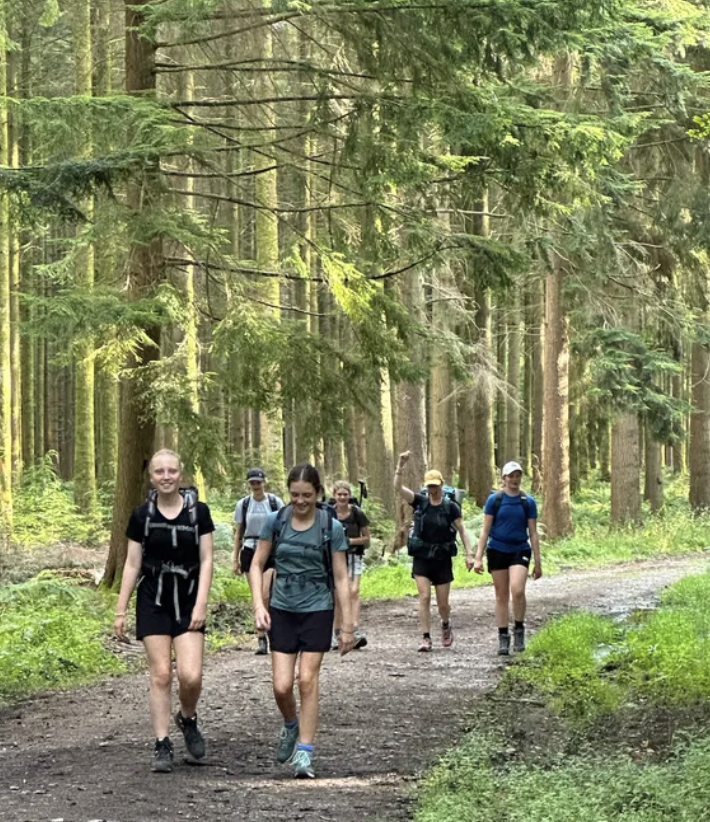
However simple it sounds: a connecting walk.
People go out in pairs and are given a few questions that relate to the theme of the day.
The instructions are simple: one shares, the other listens — not just with their ears, but with all their senses. What do you see in the other person? What do you feel while someone tells their story? Silences are allowed. Only once someone is completely done sharing do the roles switch.
This is often already quite a challenge. How often do we really listen, without meanwhile being busy with our own thoughts, answers, or ideas? How do you stay present and connected to the other person?
Sometimes I add an extra assignment. Then participants go looking along the way for various animals, plants, or trees, for which points can be earned. I find that interesting, because in a sense two investigations take place at the same time: one is about yourself, about what's happening inside; the other is about the world around you. At the same time you're still connected to the person next to you. How do you divide your attention? How do you really listen while staying curious about your surroundings?
That's exactly what touches so many different layers. What I see happen, both with young people and adults, is that their eyes open up to their surroundings, to the small things and to the life around them. They become aware again of where they're walking, instead of just being occupied with a screen or their thoughts.
Because there's a play element and a bit of competition attached, a lot of fun often arises. People become creative, help each other, and try just a little bit harder. And isn't it beautiful that you sometimes want to win something, while the real win lies somewhere else?
Whether you have the most points or not, the biggest win is that for a moment you were fully present. Not in your head, not in the past or the future, but here — in your body, in this moment.
In closing
I believe there's incredibly much to gain here — mentally, emotionally, and physically. Sometimes it starts with just one simple choice: going outside a little more often.
Maybe this story inspires you to live outdoors more too. Organize a meeting outside. Take your laptop outside for once. Have a phone call while walking. Or simply do something together in nature.